Erik J. de Jager, MA, Foundation Reis van de Razzia Datasets available at DANS Datastation for the Social Sciences and the Humanities: https://ssh.datastations.nl
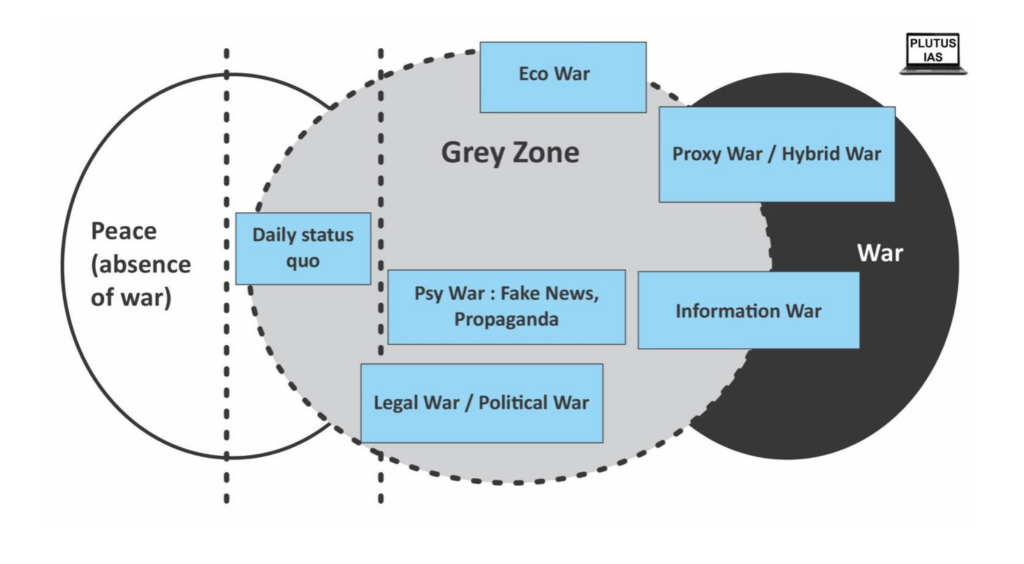
In the 21st century, conflict is no longer confined to battlefields or declared wars. Instead, it increasingly unfolds in the shadows—through cyberattacks, disinformation campaigns, economic pressure, and covert influence. This evolving landscape is often described as the “gray zone,” a space between peace and war where state and non-state actors pursue strategic objectives while avoiding direct military confrontation.
Within this gray zone, hybrid warfare has emerged as a dominant strategy. By blending military capabilities with non-military tools such as information manipulation, political interference, and technological disruption, actors are able to exploit vulnerabilities in open societies. These methods are designed not only to weaken adversaries, but to do so in ways that remain ambiguous, deniable, and difficult to respond to under traditional frameworks of international law and defense.
As the nature of conflict shifts, so too must the concept of defense. Civil defense is no longer limited to emergency response during wartime; it has become a continuous, proactive effort to strengthen societal resilience. Protecting critical infrastructure, safeguarding democratic institutions, and equipping citizens to navigate information threats are now essential components of national security.
The 121 year old Governors’ Association (“To Our Avail”) may have acquired relevance again as a possible local support system in times of crisis.
The 2019 publication on the Nieuwendam Governors’ Association (“To Our Avail”) documents a long-lived Dutch mutual sickness fund whose resilience rested less on formal rules than on enduring norms of trust, reciprocity, and social cohesion. Although its original economic function declined with the rise of the welfare state, the association persisted as a social network, preserving cooperative practices and relationships. This case supports the argument of Arjen Boin that small, local associations are essential to civil defence and societal resilience. Such organisations provide the social infrastructure needed for coordination and mutual support in times of crisis, demonstrating that resilience is not only built by central institutions but also sustained from the bottom up.
See also: The 2019 publication of a Chronicle of the Governors’ Association: an Investigation into the Resilience and Longevity of the Co-operative Structure of the Communal Sickness Fund ‘To Our Avail’ in the Research Data Journal for the Humanities and Social Sciences https://doi.org/10.1163/24523666-00401004
Title: Chronicle of the Governors’ Association: an Investigation into the Resilience and Longevity of the Co-operative Structure of the Communal Sickness Fund ‘To Our Avail’
Wij gebruiken cookies om onze website en onze service te optimaliseren.
Functionele cookies
Always active
The technical storage or access is strictly necessary for the legitimate purpose of enabling the use of a specific service explicitly requested by the subscriber or user, or for the sole purpose of carrying out the transmission of a communication over an electronic communications network.
Preferences
The technical storage or access is necessary for the legitimate purpose of storing preferences that are not requested by the subscriber or user.
Statistieken
The technical storage or access that is used exclusively for statistical purposes.The technical storage or access that is used exclusively for anonymous statistical purposes. Without a subpoena, voluntary compliance on the part of your Internet Service Provider, or additional records from a third party, information stored or retrieved for this purpose alone cannot usually be used to identify you.
Marketing
The technical storage or access is required to create user profiles to send advertising, or to track the user on a website or across several websites for similar marketing purposes.